



29 Mar How to Start Dropshipping with Shopify: A Practical Guide for 2026
Last month, a friend called me at midnight. He’d just watched his third YouTube video about dropshipping and couldn’t sleep. “Is this real?” he asked. “Can I actually sell stuff I never touch?”
I told him yes. And then I told him the part those YouTubers always skip.
We’ve been building ecommerce stores at GoWebs for over 10 years now. Shopify stores, WooCommerce stores, custom builds for hotels and restaurants across Bali. Some of our clients run dropshipping operations on the side. A few do it full time. The ones who make money? They all did the same boring stuff that nobody wants to film for TikTok.
So here’s what we actually tell people when they ask us about how to start dropshipping with Shopify.
What Dropshipping Actually Is (Without the Hype)
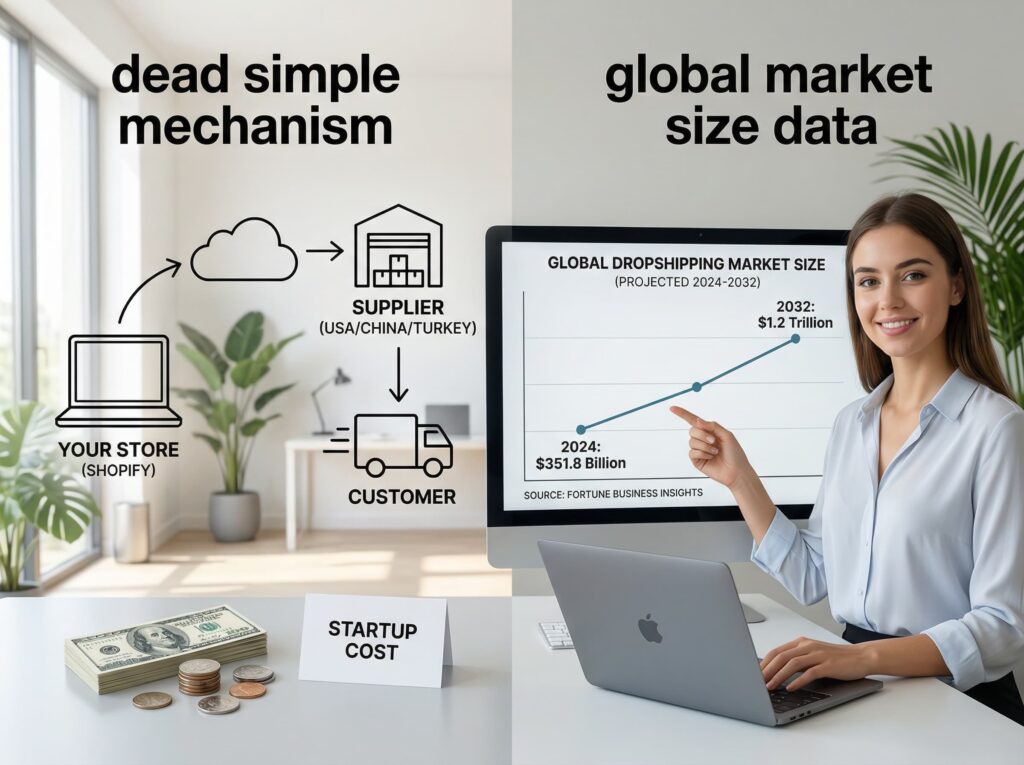
Dropshipping sounds complicated but the mechanic is dead simple. You open a store online. You put products in it. When someone places an order, your supplier — sitting in a warehouse somewhere in China or the US or Turkey — ships it straight to the buyer.
You never see the product. You never pack anything. Your job is the store, the marketing, and the customer relationship.
Shopify handles the store part better than anyone right now. I’m not saying that because we’re partners or anything — we’re not. It’s just true. More than 4.8 million stores run on the platform, and they’ve made the whole dropshipping setup embarrassingly easy. You install an app called DSers or Spocket, click “import,” and suddenly you have 50 products in your store.
Total cost to get started? Somewhere around $100–150 if you’re careful. Shopify charges $39 a month for their basic plan. Domain name runs about $14 a year. The supplier apps are free at the beginner level.
Now, the market itself — Fortune Business Insights pegged global dropshipping at $351.8 billion in 2024. They’re projecting $1.2 trillion by 2032. Those are real numbers from a real research firm, not some guru’s slide deck.
But big market doesn’t mean easy money. Let me explain why.
Picking a Profitable Niche (And Why Most People Fail)
I had a client once — nice guy, ran a small café in Ubud — who wanted to start a dropshipping store selling “everything.” Phone cases, resistance bands, kitchen utensils, cat toys. All in one store. His reasoning was, “More products, more chances to sell.”
That’s not how it works.
When someone lands on a store that sells phone cases AND cat toys, they leave. It feels sketchy. Like those weird pop-up shops at the night market where everything costs 50,000 rupiah and nothing has a brand name.
You need to pick one niche. One type of person. One category of problem.
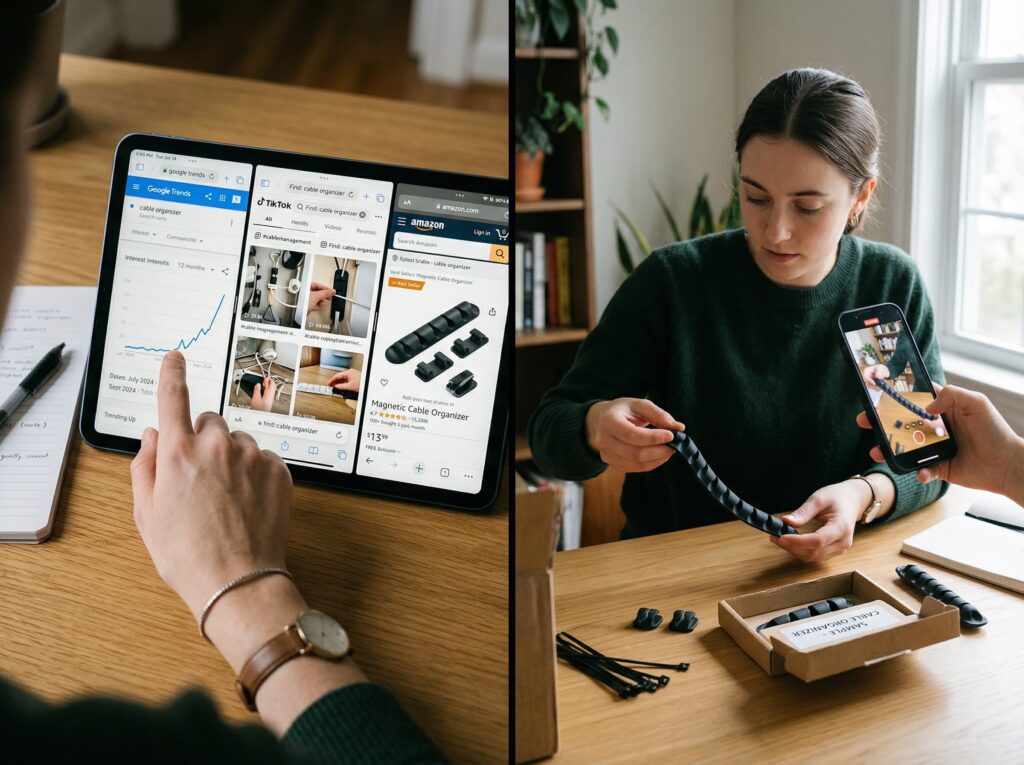
How do you find that niche? I usually tell people to start with three tabs open. Google Trends in one — type in your product idea and see if the search volume is going up or down over the past 12 months. TikTok in another — search the product name and see if people are posting about it, buying it, reviewing it. Amazon Best Sellers in the third — because if something is selling well on Amazon, there’s proven demand.
Good dropshipping products tend to share a few traits. They’re small and light, so shipping doesn’t eat your margin. They cost between $15 and $75 — cheap enough for impulse buys, expensive enough that you actually make money. And they’re not the kind of thing people just grab at their local supermarket.
Pet water bottles for hiking. Under-desk cable organizers. Scalp massagers. Weird, specific stuff that solves a small but annoying problem.
For Shopify dropshipping suppliers, the beginner move is DSers connected to AliExpress. Massive catalog. Easy to use. The downside? Shipping from China takes two to three weeks. That’s a long time for someone who’s used to Amazon Prime showing up tomorrow.
If that bothers you — and it should — look at Spocket. They connect you to suppliers in the US and Europe. Shipping drops to two to seven days. Your margins get thinner, but you get fewer angry emails.
Before you list anything, order it yourself. I can’t say this loud enough. Buy the product. Wait for the delivery. Open the package. Use the thing. If it feels cheap or takes forever to arrive, your customer is going to feel the same way — except they’ll leave you a one-star review on top of it.
Setting Up Your Shopify Store (The Right Way)
People get stuck here. They spend three weeks picking a theme color and debating fonts when they haven’t sold a single thing yet.
Sign up for Shopify. Pick a free theme. Dawn works. Sense works. They look clean, they load fast, and they won’t cost you anything while you’re still figuring things out. You can upgrade to a fancy premium theme later, after you’ve made some sales and know this is worth investing in.
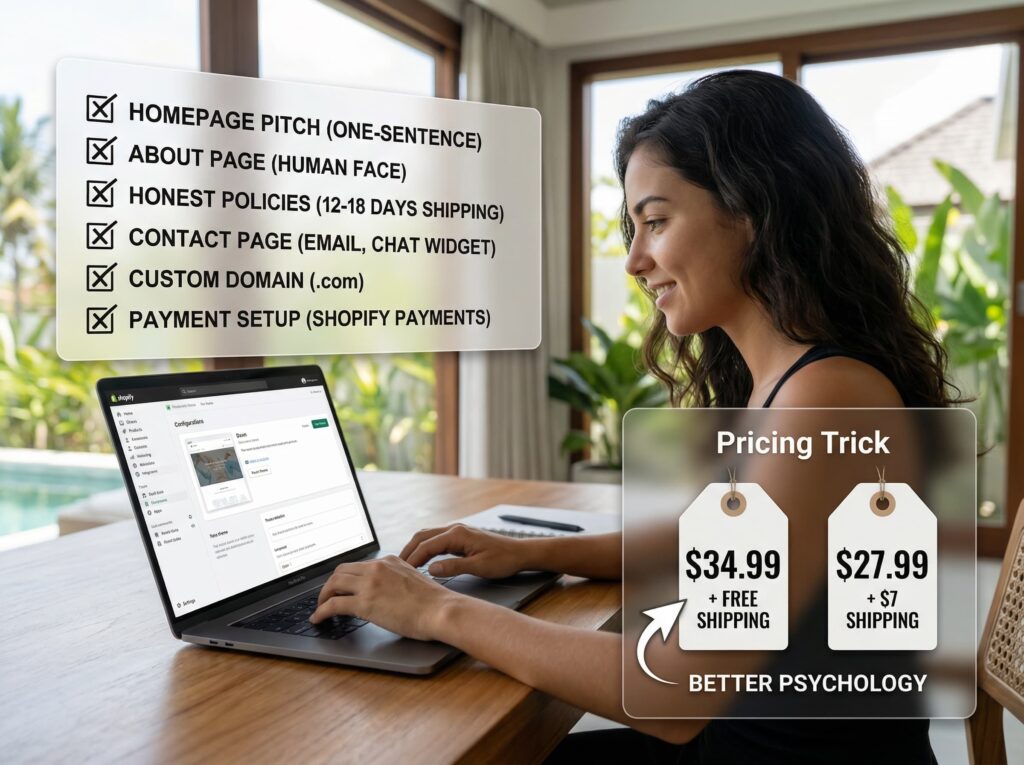
What you actually need before opening day is pretty short. A homepage that explains — in one or two sentences at the top — what you sell and who it’s for. Product pages where the description is written by you, not copied from AliExpress. Because those default descriptions? They read like someone ran them through Google Translate three times, and your competitors all have the same ones.
You need an About page. A real one. Even if you’re running this from your bedroom in Denpasar, tell people why you started the store. Give it a human face.
Shipping and return policies. Be honest about delivery times. If it’s going to take 12–18 days, say so. People handle slow shipping fine when they know about it upfront. What they don’t handle is being surprised.
A contact page. This sounds obvious, but I’ve seen stores — expensive, well-designed stores — with no email address, no phone number, no chat widget. Nothing. Why would anyone hand over their credit card to a store they can’t reach?
Set up Shopify Payments so you don’t get dinged with extra transaction fees on every sale. Add PayPal because some people just won’t buy without it. Buy a custom domain — something like yourstorename.com — because the default .myshopify.com URL makes it look like you set this up yesterday during your lunch break. Maybe you did, but your customers don’t need to know that.
Pricing trick that works and I’m not sure why more people don’t use it: add your shipping cost into the product price, then offer free shipping. A product listed at $34.99 with free shipping outsells the same product at $27.99 plus $7 shipping. Every single time. The total is identical. The psychology isn’t.
Marketing Your Store: Getting Your First Customers
This is where it gets uncomfortable. Your store is ready. Your products look great. And your daily visitor count says… two. One of them is your mom. The other is you, checking if the site is still up.
Getting eyeballs on a brand-new store takes either money or time. Usually both.
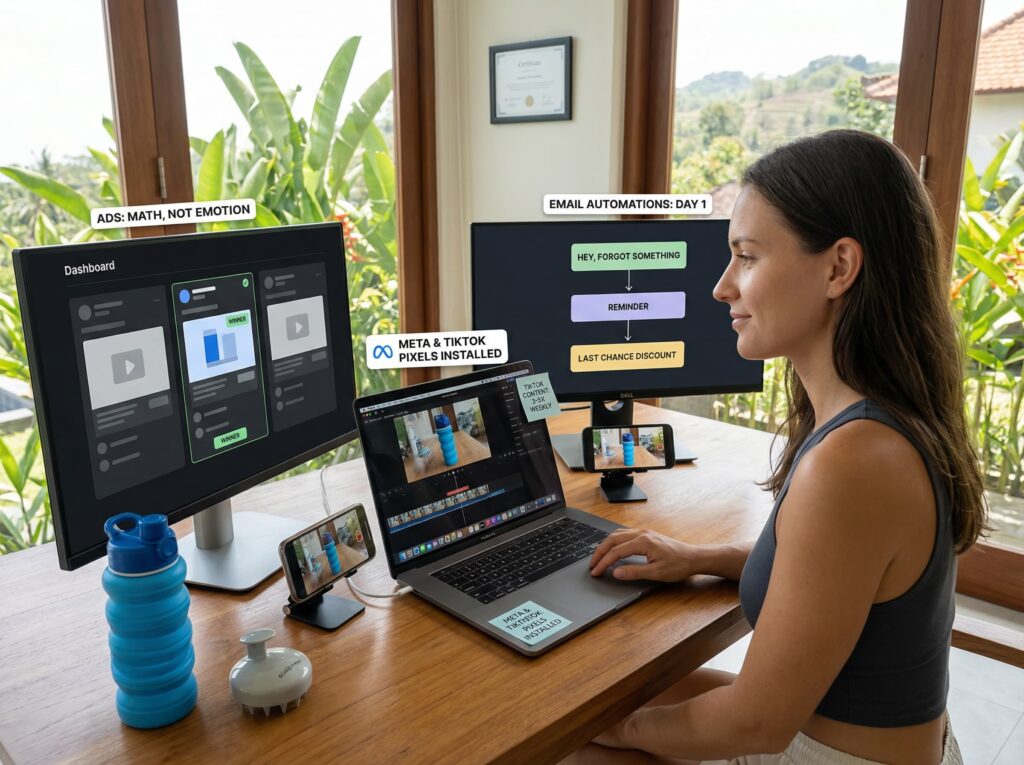
If you have some budget for ads, Facebook and Instagram are still the default starting point. Set aside $10–20 per day. Don’t run one ad and hope for the best — make three or four versions with different images and different text. Let them run for about three days. Whichever one is getting clicks and sales, put more money behind it. Kill the rest. This isn’t emotional. It’s math.
TikTok ads are worth trying too, especially if your product looks good on video. A 15-second clip of someone unboxing the thing or using it in real life — filmed on a phone, no production crew — often performs better than anything a professional agency would put together. The raw look works on TikTok. People scroll past anything that looks like an ad.
If you’re broke or just patient, go organic. Post videos on TikTok showing the product. Not a sales pitch — just the product doing what it does. A dog drinking from that collapsible water bottle. Someone organizing their desk cables in under a minute. That kind of content. Three to five posts a week. Some will get 200 views. One might get 200,000. You don’t know which one until you post it.
Here’s the thing I wish someone had told me when we started helping clients with ecommerce: set up your email automations on day one. Before ads. Before TikTok. Before anything.
Because roughly 70% of people who put something in their cart will leave your store without buying. That number comes from Baymard Institute, and it hasn’t really budged in years. A simple three-email sequence — “Hey, you forgot something,” then a reminder the next day, then a “last chance” email with maybe a small discount — that brings back somewhere between 5 and 10% of those people. It runs automatically. You set it up once.
Also install the Meta Pixel and TikTok Pixel right away. Even if you’re not spending on ads today. These little bits of tracking code record who visits your store. So when you’re ready to run ads next month, you already have an audience to target. Skip this step now and you lose all that data permanently.
Scaling Your Dropshipping Business (Without Losing Your Shirt)
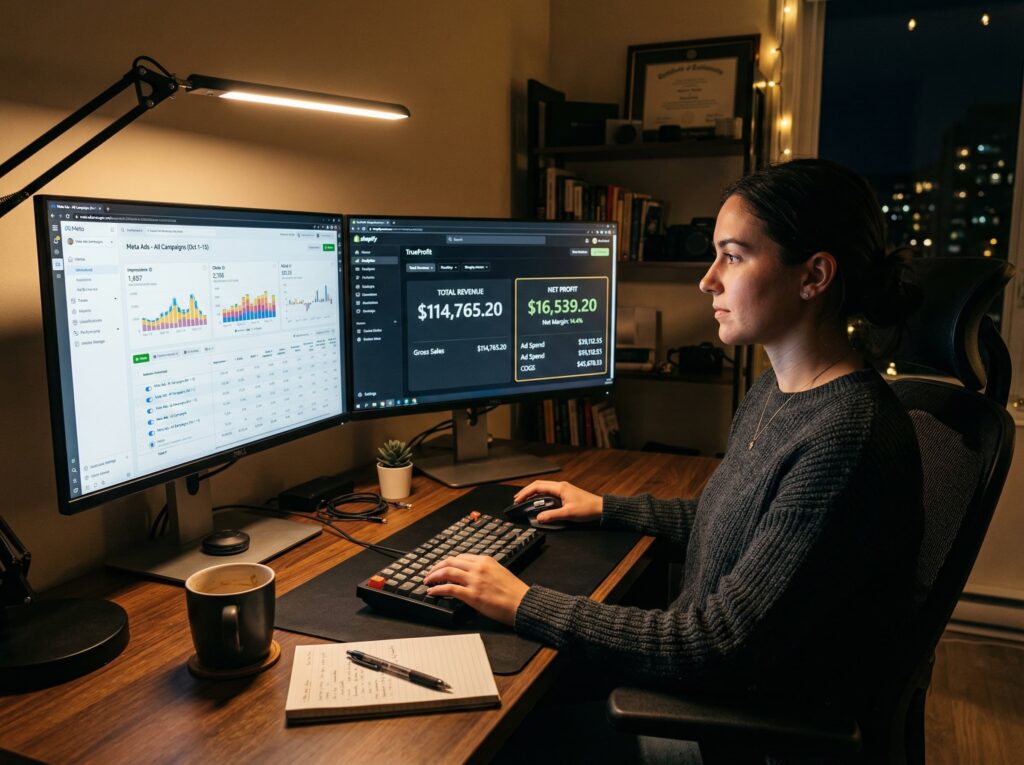
The first sale is a rush. I won’t pretend it isn’t. Even for us, when we launch a client’s ecommerce store and that first order notification pops up — it still feels good after ten years.
But here’s where most dropshipping stores quietly die. Not at zero sales. At 50 sales.
Because the owner looks at revenue and thinks things are going great. $4,000 last month! But after you subtract the product cost, the shipping, the $800 in Facebook ads, Shopify’s fee, the three apps running at $29 a month each, and PayPal’s transaction cut — the actual profit was $340.
You need to track real profit per product from the start. Tools like BeProfit and TrueProfit plug into Shopify and show you the actual numbers. Not revenue. Profit. The difference between those two words is the difference between a business and a hobby that costs money.
When you find a product that’s actually making you money after all costs, grow the ad spend slowly. About 20% more every three days or so. Facebook’s ad system gets confused when you double a budget overnight — your cost per sale will spike, and you’ll panic and turn everything off. Slow and steady. Boring. Effective.
Stay in your lane. If you’re selling pet accessories and it’s working, add more pet accessories. Don’t jump to phone cases because some guy on TikTok said they’re hot right now. Scattered stores don’t build repeat buyers, and repeat buyers are where real ecommerce money lives.
Customer service — and I mean this — will make or break you faster than any product choice or ad strategy. Reply to every message within a day. When someone’s order is late or damaged, fix it quickly and be generous about it. Refund them. Send a replacement. Whatever it takes. Because a single chargeback costs you $15–25 in fees, and if you rack up too many, Shopify Payments will freeze your account. We’ve had clients come to us after that happened. There’s not much you can do at that point except start over.
The long-term path for serious dropshippers looks something like this: you start generic, testing products and figuring out what sells. Once you find your winners, you move to a supplier like CJ Dropshipping who can add your own logo and branded packaging. And eventually — maybe six months in, maybe a year — you start ordering your best-selling products in bulk and keeping some inventory. Shipping gets faster. Margins get better. Customers come back.
Dropshipping on Shopify isn’t the overnight money machine that the internet wants it to be. It’s a real business, with real people on the other end expecting their order to show up looking like what they saw in the photos.
But the startup cost is low enough that you can test the idea without remortgaging anything. The tools are genuinely good. And the market is still growing fast enough that there’s room for someone who’s willing to do the work that most people won’t.
If that’s you, go build the thing.
Want us to build your Shopify store properly from the start? We’ve been building ecommerce stores for 10 years — from Company Profile to Hotel & Restaurant to full ecommerce operations. We know what actually drives sales, and we’ll tell you straight if something isn’t going to work. Let’s talk.
FAQs
1. What exactly is dropshipping and how does it work on Shopify?
2. How much money do I need to start a Shopify dropshipping store?
3. How do I pick the right niche for my dropshipping store?
Don’t try to sell everything. That’s the fastest way to fail. Pick one audience and one type of problem. To find your niche, open Google Trends and check whether interest in a product is going up or down. Search for it on TikTok to see if people are already talking about it. Check Amazon Best Sellers to confirm real demand. Good dropshipping products are usually small, lightweight, priced between $15 and $75, and not the kind of thing people grab at their local grocery store.
4. Which suppliers are best for beginners?
Most beginners start with DSers connected to AliExpress. The catalog is massive and setup takes about ten minutes. The tradeoff is shipping — orders from China take two to three weeks, and that can hurt your reviews. If faster delivery matters to you, look at Spocket. They work with suppliers in the US and Europe, and shipping usually lands within two to seven days. Margins are tighter, but your customers actually get their orders before they forget they placed them.
5. Should I order samples before listing products?
Yes. Always. This is the one step most beginners skip, and it costs them later. Buy the product yourself. Time how long the delivery takes. Open the package. Use the thing. If the quality feels cheap or the packaging looks sloppy, your customer will feel the same way — except they’ll leave a one-star review and file a chargeback. Spending $20 on a sample can save you hundreds in refunds and bad ratings down the road.
6. What pages does my Shopify store need before I launch?
At minimum you need a homepage that clearly explains what you sell and who it’s for. Product pages with descriptions you wrote yourself — not the broken English that comes copy-pasted from AliExpress. An About page with a real story behind your brand. Shipping and return policies that are honest about delivery times. And a contact page with an actual way to reach you. Stores with no contact information don’t get sales. They get bounced.
7. How do I get my first customers when nobody knows my store exists?
Two paths — paid or organic. For paid, start with Facebook and Instagram ads at $10–20 per day. Make three or four ad versions with different images and copy, run them for three days, kill the ones that aren’t working, and put more money behind the winner. For organic, post TikTok videos showing your product in real life — not a sales pitch, just the product doing what it does. Three to five posts a week. And set up abandoned cart emails on day one, because about 70% of people who add something to their cart leave without paying.
8. Why do most dropshipping stores fail even after getting sales?
They die at 50 sales, not zero. The owner sees $4,000 in monthly revenue and thinks everything is going great. But after subtracting the product cost, shipping, ad spend, Shopify’s fee, app subscriptions, and transaction fees — the actual profit might be $340. Or less. You need to track real profit per product from the start using tools like BeProfit or TrueProfit. Revenue and profit are two very different numbers, and confusing them is how people run a money-losing business for months without realizing it.
9. Is Shopify dropshipping still profitable in 2025?
It is. The global dropshipping market hit $351.8 billion in 2024 and is projected to reach $1.2 trillion by 2032, according to Fortune Business Insights. The market is growing, Shopify’s tools keep getting better, and the barrier to entry is still low. But “profitable” doesn’t mean “easy.” You still need to research products, test ads, handle customer service, and stick with it through the first couple of months when sales are slow and you’re spending more than you’re making.

No Comments